
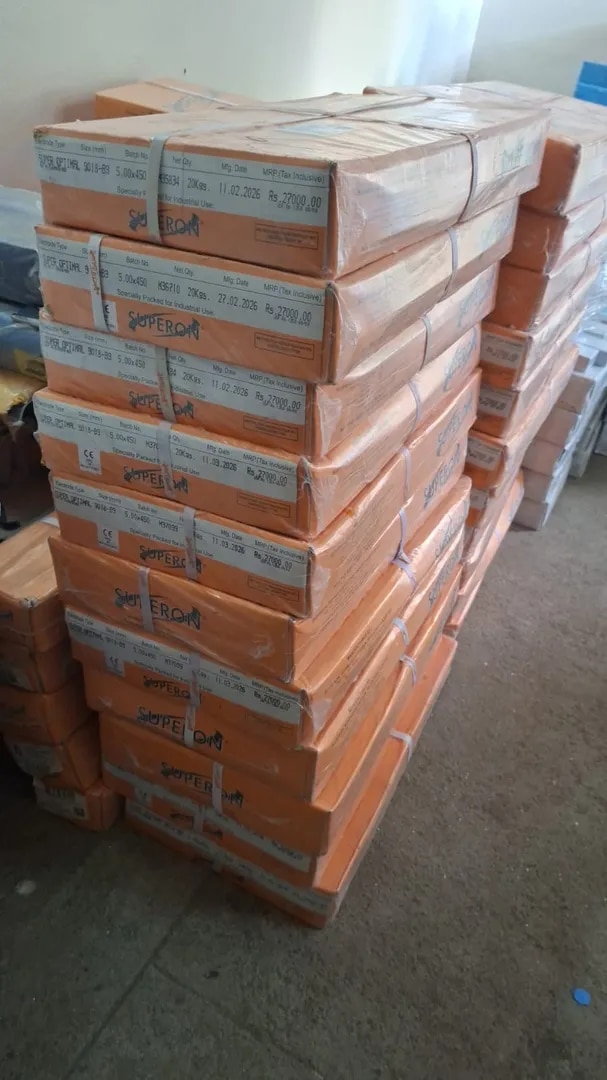
Superon 9018 B9 Welding Electrode
Description
The 9018-B9 is a specialized electrode designed for welding Modified 9Cr-1Mo steels (commonly known as P91/T91). These steels are used in extreme environments where high temperature and high pressure are constant factors.
1. Key Features
• Creep Resistance: Modified with Niobium (Nb) and Vanadium (V) to provide excellent long-term creep rupture strength.
• Low Hydrogen: Designed to minimize the risk of hydrogen-induced cracking.
• All-Position Welding: Suitable for use in all positions (Flat, Horizontal, Vertical-up, and Overhead).
• Stability: Provides a stable arc with low spatter and easy slag removal.
2. Typical Applications
These electrodes are the industry standard for critical infrastructure, including:
• Power Plants: Main steam piping, headers, and turbine casings.
• Oil & Gas: Refinery units, coal liquefaction, and gasification plants.
• Boilers: High-temperature superheater tubes and heat exchangers.
• Industrial Service: Any application operating at temperatures up to 600°C.
3. Technical Specifications
Property Specification / Value
AWS Classification AWS A5.5 E9018-B91
Coating Type Basic, Low Hydrogen (Potassium, Iron Powder)
Current / Polarity DC+ (DCEP) or AC
4. Chemical Composition (Weld Metal %)
The performance of this electrode comes from its precise alloy mix:
• Chromium (Cr): $8.0 text{ - } 10.5%$
• Molybdenum (Mo): $0.85 text{ - } 1.10%$
• Vanadium (V): $0.15 text{ - } 0.30%$
• Niobium (Nb): $0.02 text{ - } 0.10%$
• Nitrogen (N): $0.02 text{ - } 0.07%$
________________________________________
5. Important Welding Guidelines
Note: Because P91/T91 steels are sensitive to cooling rates, the following steps are mandatory for a successful weld:
• Preheating: Maintain a preheat and interpass temperature between 200°C and 300°C.
• Re-drying: Electrodes should be baked at 350°C - 400°C for 1–2 hours before use to ensure they are moisture-free.
• PWHT: Post-Weld Heat Treatment is typically required to ensure the mechanical integrity of the joint.