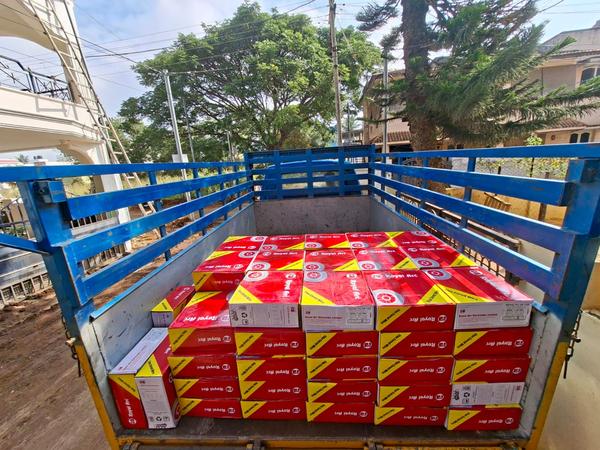
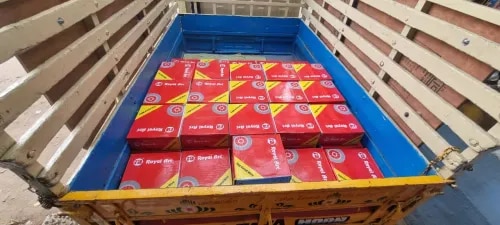
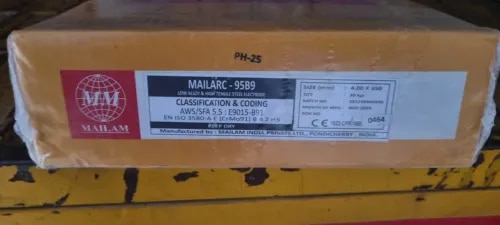
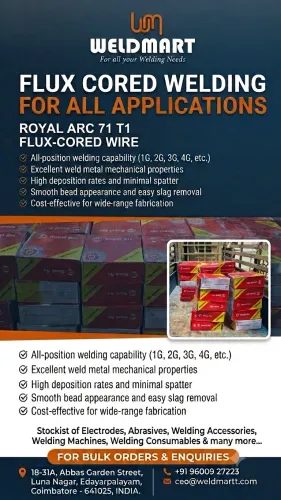
The Royal Arc 71T-1 is a high-quality, rutile-type Flux-Cored Arc Welding (FCAW) wire designed for all-position welding of mild and medium-tensile steels. It is one of the most widely used wires in the industry due to its versatility and ease of use. Below is a detailed breakdown of its characteristics, applications, and technical specifications. Core Characteristics The “71T-1” classification tells us several things: the 7 indicates a minimum tensile strength of 70,000 psi, the 1 means it can be used in all positions (flat, horizontal, vertical, and overhead), and the T-1 refers to the flux type (rutile) and its usability characteristics. All-Position Capability: The slag is designed to freeze quickly, which helps support the molten weld pool when welding vertically up or overhead. Arc Performance: It provides a very stable, smooth spray-like arc with minimal spatter. Slag Removal: The slag is generally self-peeling or very easy to remove, leaving a clean, bright weld bead with a smooth ripple profile. Shielding Gas: This wire requires an external shielding gas, typically either 100% CO 2 or a 75−80% Argon/Balance CO 2 mixture. Technical Specifications Feature Details AWS Classification AWS A5.20 E71T-1C / E71T-1M Polarity DC+ (DCEP - Electrode Positive) Shielding Gas 100% CO 2 or Argon/CO 2 Mix Tensile Strength ≈480−600 MPa Yield Strength ≈400 MPa min. Elongation 22%−30% Export to Sheets Common Applications Because of its high deposition rate and efficiency compared to traditional stick (SMAW) welding, the Royal Arc 71T-1 is a “workhorse” in the following sectors: Shipbuilding and Marine Repairs: Excellent for long seams and out-of-position hull work. Structural Steel Fabrication: Used in building frames, bridges, and trusses. General Manufacturing: Ideal for heavy machinery, earth-moving equipment, and pressure vessels. Storage Tanks: Highly effective for circumferential and longitudinal welds on large tanks. Best Practices for Use Wire Stick-Out: Maintain a “Contact Tip to Work Distance” (CTWD) of roughly 15–20mm. A stick-out that is too short can cause bird-nesting or tip fusion. Storage: Like all flux-cored wires, it should be stored in a dry environment to prevent moisture pickup in the flux, which can lead to hydrogen-induced cracking or porosity. Ventilation: FCAW produces more smoke/fume than MIG welding; ensure proper extraction or use in well-ventilated areas.